
Getting Started
What Happens at an ABA Assessment? What Parents Should Expect

Written by the Golden Touch ABA clinical team. Medically reviewed by Lily Palmer, M.Ed., BCBA, LBA
October 27, 2026 · 10 min read
The diagnosis is in hand, the insurance check came back fine, and now a BCBA is coming to your house on Thursday for something called an assessment. Most parents hear that word and picture a test, with a score, that their child could do badly on. A few quietly start practicing colors and shapes in the days before.
Please do not. The assessment is not a test your child can fail. It is the hour or two where the person who will design your child's program finds out who your child actually is, what they can already do, and what is getting in the way at home. Here is what that visit looks like at Golden Touch ABA, the questions you will be asked, and what happens to all of it afterward.
What is an ABA assessment?
An ABA assessment is a Board Certified Behavior Analyst's evaluation of your child's current skills, challenges, and daily routines, completed before therapy begins. It has three parts: a long conversation with you, direct time with your child, and standardized skills checklists. The output is a written treatment plan with specific goals and a recommended number of hours per week. That plan is what your insurance company reviews when it decides whether to authorize therapy.
Parents often mix this up with the evaluation that diagnosed autism in the first place, so it helps to see the two side by side.
| Diagnostic evaluation | ABA assessment | |
|---|---|---|
| Who does it | A psychologist, developmental pediatrician, or other diagnosing clinician | A BCBA from your ABA provider |
| Question it answers | Does my child have autism? | What should therapy work on, and how much is needed? |
| Typical tools | ADOS-2, developmental history, cognitive testing | VB-MAPP, ABLLS-R, Vineland-3, AFLS, functional assessment |
| Where | A clinic or hospital | Your home, at Golden Touch |
| What you get | A diagnostic report | A treatment plan and an hours recommendation |
| When it happens | Once, before ABA can be authorized | Before therapy starts, then again about every six months |
You need the first one before the second can happen. If you are still working on the diagnosis, our guides to getting an evaluation in Utah and Maryland cover who can diagnose and how to shorten the wait.
Who does the ABA assessment, and where?
A BCBA does it, and at Golden Touch it happens in your home. A BCBA is a master's level clinician who has passed a national board exam and holds a state license, and the assessment is one of the things only a BCBA can do. The behavior technician who will later run most of the sessions is not part of this visit.
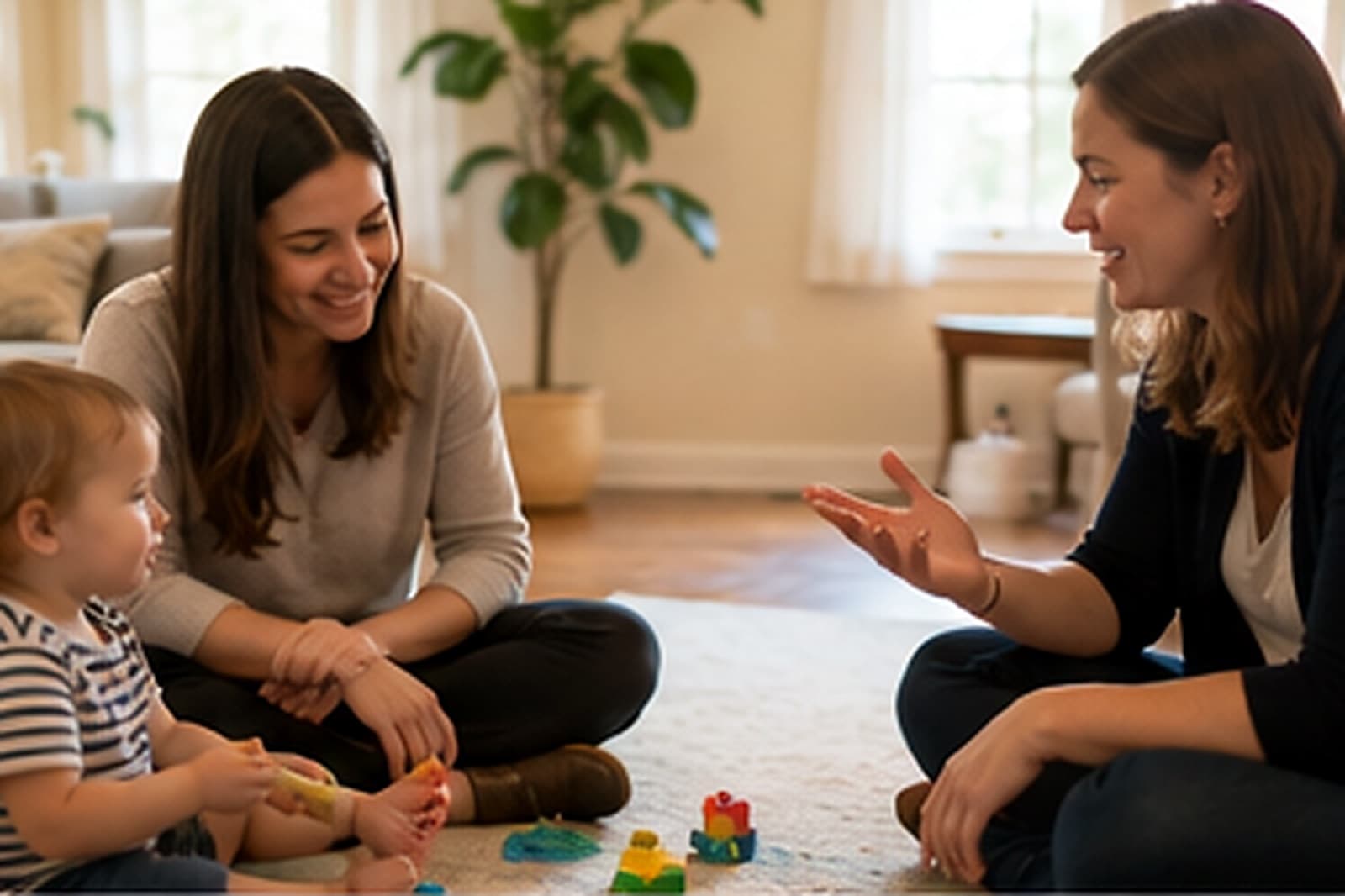
Doing it at home matters more than it sounds. A child who will not speak to a stranger in an office with fluorescent lights will often chatter away on their own bedroom floor. The BCBA also gets to see the real kitchen where mealtimes fall apart, the real front door that transitions happen at, and the real sibling who keeps taking the tablet. Everything in the plan will be built for that house, not for a clinic room your child will never be in.
One more thing that is specific to how we work: the BCBA who assesses your child is the one who writes the plan and then visits every week to run it. Across much of the industry an assessing clinician hands the file to someone else, and the supervising BCBA may carry 15 to 20 or more families and show up every other week or less. Ours average about ten. The person asking you questions on Thursday is the person you will be texting in March.
What happens during the assessment, step by step?
The assessment runs from a records review before the visit through a plan review meeting a few weeks later. Here is the sequence most families go through with us. The timing shifts for every child, and a toddler and a teenager will see very different versions of the middle steps, but the order holds.
- Before the visit · Records and authorization
We collect the diagnostic report, insurance information, and any school or therapy records you have. Insurance plans authorize the assessment itself before it happens, usually as a block of hours that covers the visit, the scoring, and the write-up. Our intake team handles that request. You will get a call to schedule once it clears.
- Visit, first hour · The parent interview
The BCBA sits down with you, often at the kitchen table, and asks about an ordinary day from waking to bedtime. Communication, eating, sleep, toileting, play, siblings, what your child loves, what sets them off, and what you have already tried. This part is long on purpose. It is the fastest way to learn what the data will later confirm.
- Visit, next hour or two · Time with your child
The BCBA gets on the floor. At first it is just play, following your child's lead with whatever they are into, so your child decides this new adult is fine. Then the BCBA starts quietly checking specific skills inside the play: does your child ask for things, copy an action, follow a one-step direction, match pictures, take turns, point at what they want. Each one is noted as present, emerging, or not yet.
- Visit, woven through · Watching the hard parts
If challenging behavior is part of why you called, the BCBA wants to see a little of it, or at least the lead-up. They may ask you to do the thing that usually triggers it, like ending screen time, while they watch what happens before and after. That pattern tells them what the behavior is doing for your child, which is the only way to plan a good response to it.
- Sometimes · A second visit
For an older child, a child with a lot of goals, or a child who was having a rough day, the BCBA may come back for a second session rather than push through. Nothing is wrong when this happens. A plan built on a cranky, sick afternoon is a bad plan.
- After the visit · Questionnaires and scoring
You will likely fill out a standardized form about daily living skills, usually the Vineland. The BCBA scores everything, compares it to what they saw, and turns it into a skills profile across communication, social, play, self-care, and behavior.
- One to two weeks later · The treatment plan
The BCBA writes the plan: measurable goals in each area, a recommended number of weekly hours, parent training goals, and, if needed, a specific behavior plan. It goes to your insurance plan for authorization.
- Before therapy starts · Plan review with you
You and the BCBA walk through the plan together. Every goal should make sense to you. If one does not, or if the thing you care most about is missing, say so. The plan is edited before anyone signs it, and the first sessions get scheduled.
What assessment tools do BCBAs use?
Most BCBAs use one or two standardized skills checklists plus a functional assessment of any challenging behavior. The checklists are not pass-or-fail tests. They are long inventories of skills, organized by developmental level, that let the BCBA mark exactly where your child is and measure change later. Which ones get used depends on your child's age and needs.
| Tool | What it looks at | Usually used for |
|---|---|---|
| VB-MAPP | Language and early learning skills, plus the barriers that get in the way of learning | Toddlers and preschoolers, and anyone still building language |
| ABLLS-R | A broad inventory of language, academic, self-help, and motor skills | Preschool through early school age |
| Vineland-3 | A parent questionnaire on everyday adaptive skills: communication, daily living, socialization | All ages; many insurance plans ask for it at every reassessment |
| AFLS | Functional living skills: home, community, school, and independence | Older children, teens, and young adults |
| Functional behavior assessment | Why a specific challenging behavior happens, based on what comes before and after it | Any child whose plan needs to address a behavior |
Ask your BCBA which tools they used and why. A good answer takes a minute and makes the plan easier to understand. If the answer is vague, that tells you something too.

How long does an ABA assessment take?
Plan on 2 to 4 hours of direct time with your child, often across one or two visits, plus about an hour of interview with you. Insurance plans typically authorize the assessment as a block of 15-minute units, and many approve up to 32 units, which is 8 hours. That block is meant to cover the visit, the scoring, and the writing, not just the time on your floor. The write-up usually takes the BCBA longer than the visit did.
From the first visit to an approved plan, most families are looking at two to four weeks. The variable is the insurance review. Some Medicaid plans turn a plan around in days. Some commercial plans take the full two weeks and come back with questions. We follow up on every one of them, and you will hear from us while it sits.
What questions will the BCBA ask me?
Expect a detailed conversation about ordinary life, more than you think you were signing up for. These are the questions that come up in almost every interview:
- Walk me through a normal weekday, from waking up to asleep.
- How does your child let you know what they want? Words, pointing, pulling you by the hand, a device, crying?
- What does your child love? What could they do for an hour?
- How do meals go? Sleep? Bath? Getting dressed? Leaving the house?
- When things fall apart, what usually happened right before, and what happens right after?
- Is there anything that worries you about safety? Running off, climbing, putting things in their mouth?
- What have you already tried, and what helped even a little?
- What does the rest of the family's schedule look like?
- If we talk again in six months, what would you want to be different?
That last question is the one to think about ahead of time. Parents sometimes answer it with what they think a clinician wants to hear. The honest version, which might be "I want to be able to take both kids to the grocery store," is far more useful, and it is the kind of goal a good plan is built around.
Nothing you say is being judged. Describing the hour your child spent screaming on the floor of Target is not a confession. It is the clearest clinical information the BCBA will get all day.
How should I prepare my child and the house?
Mostly, by not preparing. The BCBA needs to see what your child can do today, on their own, in their real environment. A child who was drilled on colors for three days gives a false reading, and the goals get set in the wrong place. A few practical things do help:
- Keep the usual routine. Normal nap, normal snack, the same tablet rules as any other day.
- Have your child's favorite things within reach: toys, snacks, a show, a game. The BCBA will want to use them.
- Do not tidy up for us. Leave the house the way it is on a Thursday.
- Siblings can be home. How your child plays with, ignores, or fights with a brother is information.
- Have the diagnostic report, insurance card, and any IEP, speech, or OT reports handy. Photos on your phone are fine.
- Write down the two or three things you most want help with, so they do not get lost in a long conversation.
For a school-age child or a teenager, tell them a little about who is coming and why, in plain terms: someone who is going to help with the things that are hard, and who wants to hear what they think. Older kids should have a say in their own goals, and a good BCBA will ask them directly.

What if my child melts down or will not participate?
Then the BCBA sees exactly what you have been describing, and the assessment is still a good one. Children refuse, hide in bedrooms, cling to a parent, or fall apart over the stranger on their rug. None of it ends the visit. The BCBA will back off, give your child space, and often get more done from the doorway than they would have with a cooperative child at a table.
What a meltdown during the assessment does change is the plan. The BCBA now knows what the first few weeks of therapy need to look like: slower pairing, fewer demands, more time just becoming someone your child is glad to see. If the day was so far from normal that the BCBA could not get a fair picture, they will come back. That is a scheduling note, not a setback.
What happens after the ABA assessment?
You get a treatment plan, and once insurance approves it, therapy starts. The plan has four parts you should expect to see: specific, measurable goals in each skill area; a recommended number of weekly hours with the reasoning behind it; parent training goals, because your hours with your child outnumber ours many times over; and, where needed, a behavior plan that spells out exactly what everyone will do when a specific behavior happens.
Insurance authorizations usually run six months. Near the end of each one, the BCBA reassesses, using the same tools as the first time, so the progress is measured against a real baseline rather than a feeling. The reassessment is shorter than the first assessment, and by then the BCBA has been in your home every week for months, so little of it will surprise either of you. Mastered goals come off, new ones go on, and the hours recommendation is adjusted up or down to match.
The first sessions after approval look different from the ones that come later. They lean hard on pairing, so your child and their technician get to know each other before the real work begins. We wrote up what a full session looks like hour by hour if you want to see where the plan leads.
Families tell us the part they remember from this stage is not the checklists. It is whether anyone kept them in the loop while the paperwork moved. One Salt Lake City parent wrote this in a Google review:
Finding the right ABA provider felt overwhelming, but Golden Touch ABA made the entire process easy. They answered all of our questions, kept us informed every step of the way, and matched us with an amazing therapist.Mike, Salt Lake City
How do I get an ABA assessment scheduled?
Contact an ABA provider with your child's diagnostic report and insurance information, and the provider handles the rest. At Golden Touch ABA, that means a free benefit check within one business day, the assessment authorization request, and a BCBA at your door in Utah or Maryland as soon as it clears. There is no waitlist. If you would like a rough sense of what a program might include before anyone visits, our interactive ABA preview asks a few questions and shows likely focus areas, estimated hours, and a first-year timeline in a couple of minutes.

About the reviewer
Lily Palmer, M.Ed., BCBA, LBA
Board Certified Behavior Analyst, Golden Touch ABA
Lily Palmer is a Board Certified Behavior Analyst and Licensed Behavior Analyst with Golden Touch ABA, where she designs and oversees in-home ABA programs for children with autism in Utah. She holds a Master of Education and studied at the University of Utah.