
About ABA
Should You Stop Your Child's Stimming?

Written by the Golden Touch ABA clinical team. Medically reviewed by Lily Palmer, M.Ed., BCBA, LBA
October 5, 2026 · 7 min read
Most of the time, no. If your child flaps their hands when the pasta comes out, rocks during a movie, or hums the same four notes on every car ride, our advice is to let them. Stimming is how a lot of children regulate their bodies, and taking it away without replacing what it does tends to make things harder, for the child and for you.
There are real exceptions, and we will get to them. But parents are often told, sometimes by relatives and sometimes by older therapy programs, that stopping stims is the point of treatment. We disagree, and so does the direction the field has moved over the past decade. Here is how we think about it, and how to tell a stim that needs help from one that just needs room.
What is stimming?
Stimming, short for self-stimulatory behavior, is any repeated movement, sound, or action a person does because of how it feels. Everyone does some version of it. Clicking a pen, twisting your hair, bouncing a knee in a long meeting: those are stims. Autistic children tend to stim more often and in ways that are easier to notice.
Common stims in children include:
- Hand-flapping, finger-flicking, or clapping
- Rocking, spinning, jumping, or pacing
- Humming, squealing, or repeating words and phrases (echolalia)
- Lining up toys or watching wheels and fans turn
- Rubbing textures, smelling objects, or chewing on things
- Staring at lights or moving their fingers in front of their eyes
Why do kids stim?
Because it works for them. A stim almost always has a job, and once you know the job, the behavior makes a lot more sense. For one child, rocking is the brakes: the room is loud, the day has been long, and rocking brings the volume down. For another, jumping is the gas pedal, a way to wake up a body that feels sluggish. And a lot of stimming is simply joy. The child who flaps at the top of the slide is telling you they are having a great time.
Autistic adults who can describe their own stimming say much the same thing: it helps them stay calm, think clearly, and get through situations that would otherwise overwhelm them. That is worth hearing before deciding a stim has to go.

When should you step in?
Step in when a stim is hurting your child or someone else, when it is unsafe, or when it takes over so much of the day that your child cannot do the things they need or want to do. "It looks different" is not on that list. Here is a rough guide to sorting it out:
| What you see | What we would usually do |
|---|---|
| Flapping, rocking, spinning, humming, scripting lines from a show | Leave it alone. It is doing a job for your child. |
| Lining up toys, watching the same video clip over and over | Leave it alone, and maybe join in. It can be a way into play together. |
| Stimming so absorbing that your child misses meals, cannot get to sleep, or tunes out for most of the day | Worth a closer look with a BCBA, mostly to find out what is overwhelming them |
| Loud vocal stims in a classroom, or a stim your child says they want help with | Worth talking about, with your child's input. Sometimes the answer is a quieter option or a set time and place. |
| Chewing or mouthing small objects, darting toward the street | Act now. Safety comes first. |
| Head-banging, biting their hands, picking skin until it bleeds, hitting others | Act now, and call your pediatrician if it is new or getting worse |
If you are unsure which row a behavior belongs in, a few questions help:
- Is anyone getting hurt, now or likely soon?
- Does it stop my child from eating, sleeping, learning, or playing?
- Does my child seem distressed by it, or ask for help with it?
- Would I want to change it if nobody else could see it? If the honest answer is no, it is probably fine.
Does ABA therapy try to stop stimming?
Good ABA does not target harmless stims. Older programs sometimes did, and that history is a big part of why some parents are wary of ABA in the first place. A behavior plan built around making a child look less autistic is a plan built around other people's comfort. Our BCBAs do not write goals for that.
When a stim does need attention, the work looks like this. First, the BCBA figures out what the stim does for your child, by watching when it happens, what comes right before it, and what changes right after. Then the team gives your child a safer way to get the same thing:
- A child who bites their hand when overwhelmed might get a chew necklace, plus practice asking for a break before the room gets to be too much.
- A child who bangs their head for strong input might get deep pressure, a weighted lap pad, or rough-and-tumble play built into the day.
- A child whose loud humming makes it hard to stay in class might practice a quieter version, or have a spot and a time when full volume is fine.
- Sometimes the fix is in the environment, not the child: dimmer lights, headphones at the grocery store, a calmer morning routine.
Nobody should be grabbing your child's hands or punishing a stim. If a provider suggests that, ask why, and keep asking until the answer makes sense to you.
Why does it matter who is watching?
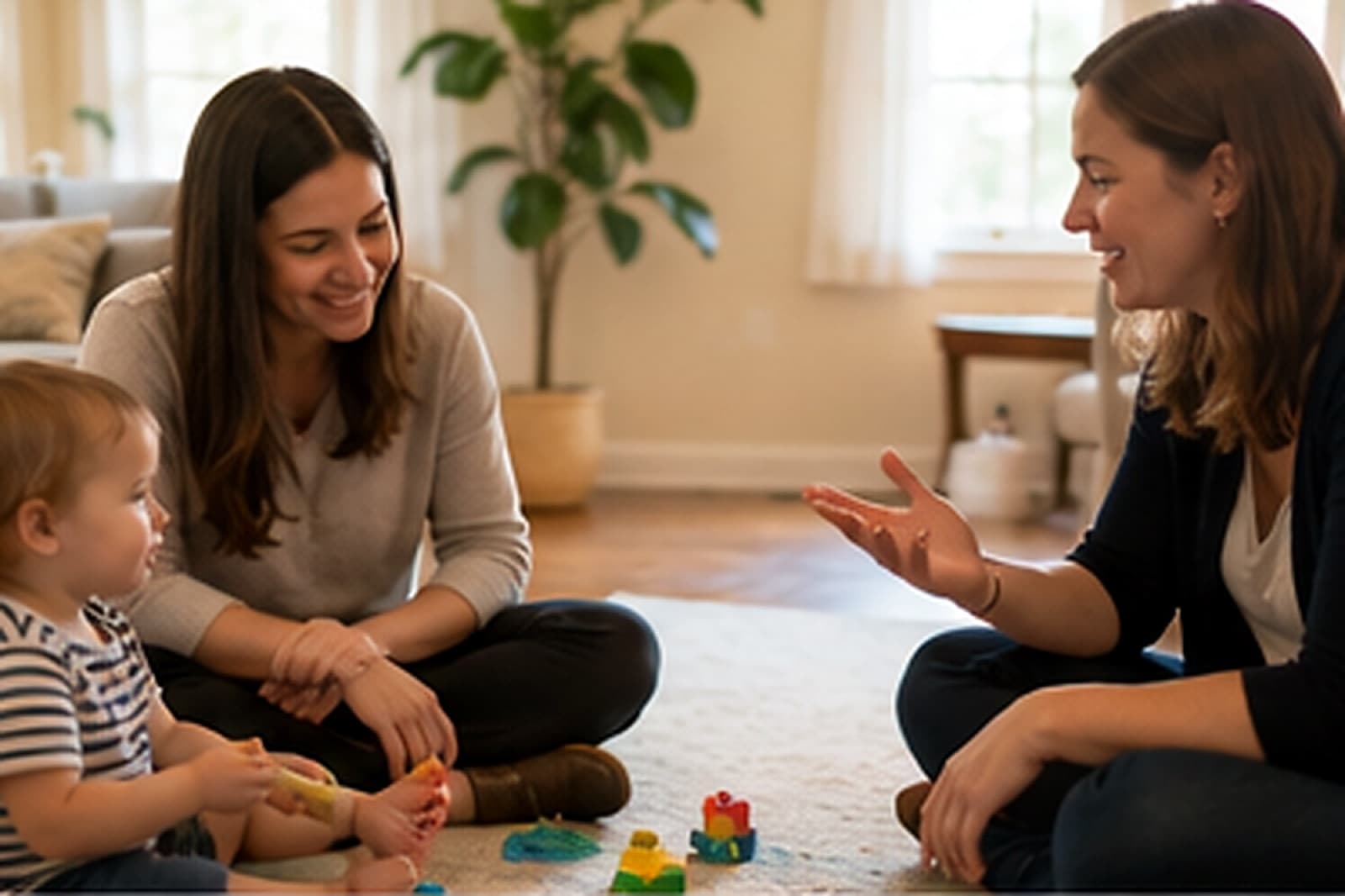
Because whether a stim is a problem depends on the details. The same hand-flapping can be pure delight on Saturday morning and a sign of overload during a loud birthday party. Telling those apart takes someone who has seen your child on ordinary days, in the places your child actually spends time.
That is one reason we do ABA at home, and why our BCBAs keep caseloads of about ten children instead of the 15 to 20 or more that is common across the industry. Your child's BCBA is involved every week, so when a parent asks "is this new rocking something to worry about?" the person answering has seen the rocking in your living room recently, not just read about it in a note. You can read more on our approach page, or see what an in-home session looks like hour by hour.
What if my child is stimming more than usual?
Treat it as information. A jump in stimming often means something else is going on: poor sleep, a change at school, a new sibling, a loud stretch of the holidays, or simply a lot of excitement. Look at what changed in the week before.
Pain is the one to rule out quickly. A child who cannot easily say "my ear hurts" or "my tooth hurts" may start hitting their head or rubbing one spot hard. If a self-injurious stim appears suddenly or gets worse fast, see your pediatrician before assuming it is behavioral.
What do I say when people stare?
Whatever is true and short. "He flaps when he is happy" is a complete answer. You do not owe a stranger a diagnosis, and your child is listening to how you describe them. Many families find that the more relaxed they are about stimming in public, the more relaxed their child is too.
With grandparents and other relatives who keep saying "make him stop," it can help to explain what the stim does: "rocking is how she calms down, and if she cannot rock, she melts down instead." Most people come around when they understand there is a reason.
Is stimming a sign of autism?
It can be one sign, but never on its own. Repetitive movements are one of the areas clinicians look at during an autism evaluation, along with communication, social connection, and play. Lots of toddlers who are not autistic flap or spin when they are excited. If repetitive movements come with other differences, like few words, not pointing or bringing you things to show you, or losing skills they used to have, it is worth asking about an evaluation. Our guide to early signs of autism by age walks through what to watch for, and getting a diagnosis explains the next step.
If your child already has a diagnosis and you are trying to figure out what ABA would actually work on, our free ABA preview asks a few questions and shows likely focus areas and weekly hours. Golden Touch ABA provides in-home therapy across Utah and Maryland, and if you want to know what your insurance covers, we will check your benefits for free within one business day.

About the reviewer
Lily Palmer, M.Ed., BCBA, LBA
Board Certified Behavior Analyst, Golden Touch ABA
Lily Palmer is a Board Certified Behavior Analyst and Licensed Behavior Analyst with Golden Touch ABA, where she designs and oversees in-home ABA programs for children with autism in Utah. She holds a Master of Education and studied at the University of Utah.