
About ABA
ABA vs Speech Therapy: Does My Child Need Both?

Written by the Golden Touch ABA clinical team. Medically reviewed by Lily Palmer, M.Ed., BCBA, LBA
November 18, 2026 · 8 min read
The pediatrician says speech therapy. The diagnostic report says ABA. The school offers a speech group. A friend says ABA is the only thing that worked. Somewhere in there a parent with a three-year-old who does not talk yet has to decide what to actually sign up for, and it is not obvious from the outside how these two therapies differ or whether one makes the other unnecessary.
Here is the short version. They are different therapies that overlap on one thing, communication, and for most autistic children with language delays they work best together. The longer version explains what each does, where the overlap is, and how to make sure two providers are pulling in the same direction.
What is the difference between ABA and speech therapy?
Speech therapy treats language and speech. ABA treats the whole set of skills a child with autism may be missing, of which communication is one. A speech-language pathologist, or SLP, is a specialist in how language works: the sounds of speech, vocabulary, grammar, understanding what is said, conversation, and also feeding and swallowing, which use the same muscles. A BCBA is a specialist in how learning works: how to teach any skill, including communication, to a child who is not picking it up the usual way, and how to reduce the behaviors that get in the way.
| Speech therapy | ABA therapy | |
|---|---|---|
| Who delivers it | Speech-language pathologist (master's degree, state license) | BCBA designs; behavior technician delivers; parents trained |
| What it targets | Speech sounds, words, sentences, understanding, social language, feeding | Communication, play, daily living, coping, safety, behavior, learning readiness |
| Typical dose | 30 to 60 minutes, one to three times a week | 10 to 40 hours a week |
| Where | Clinic, school, or sometimes home | Home (with us), clinic, or school |
| Core question | How does this child's language system work, and what is missing? | Why isn't this child communicating, and what will make it worth it? |
| Insurance | Covered under speech therapy benefits; often visit limits | Covered under autism or ABA benefits; authorized by treatment plan |
The dose difference is the one parents notice first, and it tells you something about the jobs. Speech therapy is a specialist consultation: an expert works out what the language system needs and teaches it directly, in short, focused sessions. ABA is the practice field: many hours of using communication, in real situations, with a lot of reinforcement, until it becomes the child's own.
Where do they overlap?
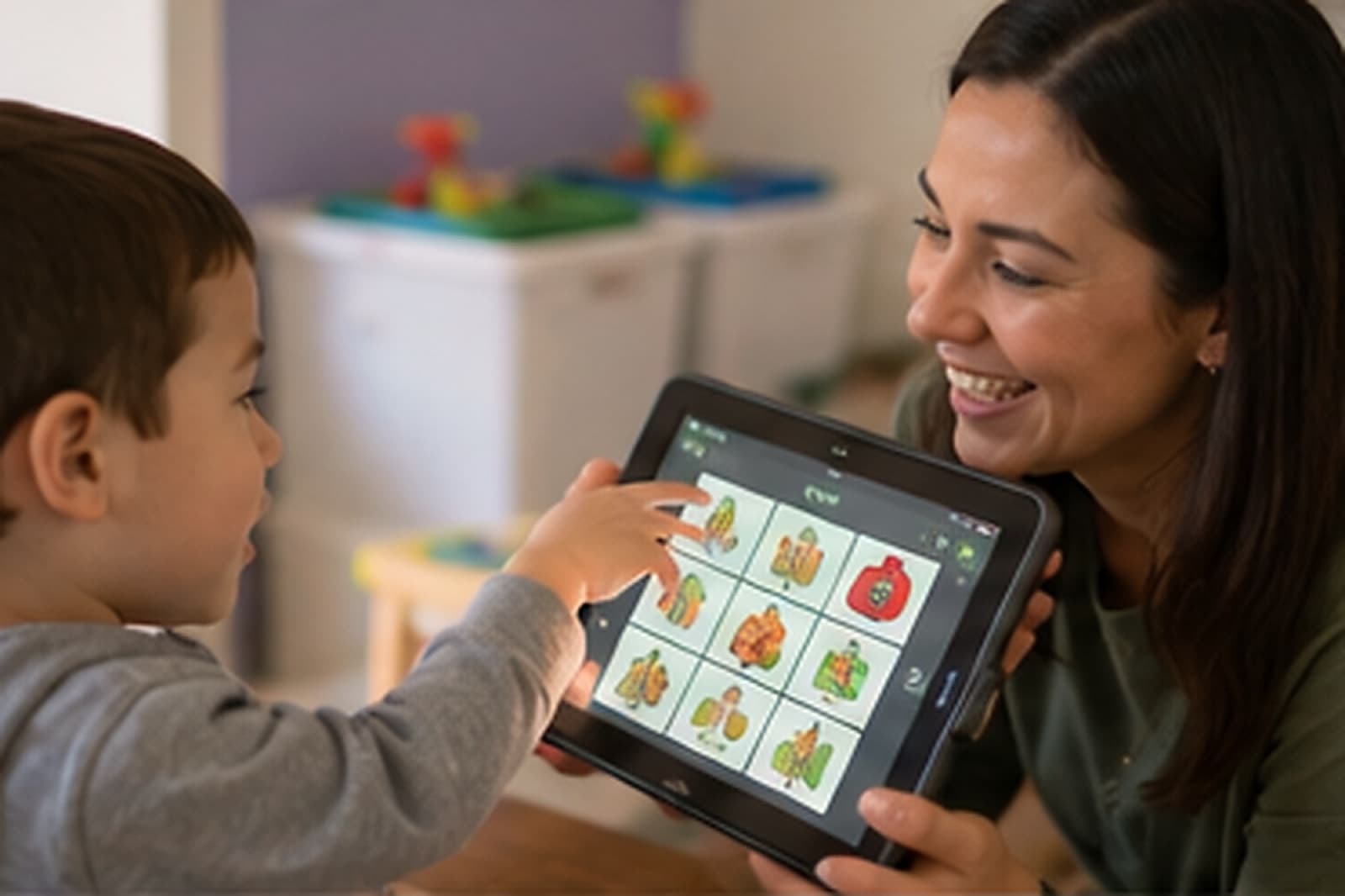
On functional communication, which is the skill of using words, signs, pictures, or a device to get what you need. Both therapies work on it, and both would say it is the first priority for a child with no reliable way to communicate. The difference is the angle. An SLP looks at the child's language and asks what the next developmental step is. A BCBA looks at the child's day and asks what the child is trying to get, in which moments, and how to make communicating the easiest way to get it. One builds the tool. The other builds the habit of reaching for it.
A concrete example. A speech therapist teaches a child the word "open" in a Tuesday session with a set of containers. The ABA technician, in the child's home on Wednesday, Thursday, and Friday, puts the favorite snack in a container the child cannot open, waits, prompts "open," and hands it over the instant the child tries. Forty times a day. By the following Tuesday the word is not something the child knows. It is something the child uses.
Does my child need both?
If your child has autism and a language delay, usually yes, and the case is strongest for children with few or no words. Here is the way to think about it for your own child.
- No words, or very few. Both. Speech therapy assesses what is possible and may introduce a device or picture system. ABA provides the hours of practice and makes communicating pay off every time, which is the thing that gets a child from one word to fifty.
- Talks, but mostly echoing or scripts. Both. The SLP works on flexible language. ABA works on using it to request, comment, and answer in real moments, and on the play and social skills that give the child something to talk about.
- Talks well, but hard to understand. Speech therapy leads, since articulation is squarely an SLP skill. ABA may not be needed for that goal at all, though it may be for others.
- Talks well, struggles with conversation and friends. Either can help, depending on the child. An SLP with a social language focus or an ABA program with social goals; sometimes both, especially for school-age children.
- Feeding or swallowing problems. Speech therapy or a feeding-trained occupational therapist for the oral-motor side, ABA for the mealtime behavior and food acceptance. We wrote about that in ABA and picky eating.
What ABA covers that speech therapy does not: toilet training, sleep, tolerating haircuts and the dentist, transitions, aggression, running off, getting dressed, playing with a sibling, sitting for circle time. Those are often the things making family life hardest, and a child who is calmer and sleeping and able to sit is also a child who learns more in speech therapy. The whole list of what a program can include is in what is ABA therapy.
How do I make sure the two therapies work together?
Ask them to talk to each other, and ask for the same goals in both plans. This is the piece families most often have to push for, because the SLP is at one clinic and the BCBA is at another and neither is paid to coordinate. It matters a lot. The words the speech therapist is teaching should be the words the ABA team is prompting. The device the SLP programmed should be the device the technician carries around the house. If the SLP wants the child signing "more" and the ABA team is pushing the spoken word, the child gets two confusing messages.
What that looks like in practice with us: with your permission, the BCBA reaches out to the SLP, gets the current speech goals, and writes communication goals into the ABA treatment plan that match them. The technician gets a copy of the device vocabulary. Progress notes go both ways. Because our BCBAs visit every family weekly and carry about ten families each, there is actually time for this, which is not always true at providers running larger caseloads.
Which should I start first?
Whichever you can get into first, and then add the other. There is no rule that one has to precede the other, and the waits are different. Speech therapy slots can be limited in some areas, and school-based speech, through an IEP or an early intervention program, is often the fastest route to an SLP. We do not keep a waitlist for ABA in Utah or Maryland, so for many families ABA is the one that can start within weeks, and the BCBA can help you find and coordinate with a speech therapist from there. If your child is under three, the state early intervention program is another place to find speech services, and we explain it in what is early intervention for autism.
Does insurance cover both?
Yes, under different parts of the plan. Speech therapy is usually covered under rehabilitative or habilitative therapy benefits, often with a visit limit per year. ABA is covered under autism treatment benefits, authorized from the BCBA's treatment plan, in Utah, Maryland, and Missouri. Medicaid covers both for eligible children. Getting both does not count against each other. Our insurance page lists the plans we work with, and the benefit check we run within a business day will tell you what your plan does with ABA specifically. For the rest of the picture, the interactive ABA preview shows what a program for your child might focus on, communication included.

About the reviewer
Lily Palmer, M.Ed., BCBA, LBA
Board Certified Behavior Analyst, Golden Touch ABA
Lily Palmer is a Board Certified Behavior Analyst and Licensed Behavior Analyst with Golden Touch ABA, where she designs and oversees in-home ABA programs for children with autism in Utah. She holds a Master of Education and studied at the University of Utah.