
Daily Life
Sleep and Autism: How ABA Supports Bedtime Routines

Written by the Golden Touch ABA clinical team. Medically reviewed by Lily Palmer, M.Ed., BCBA, LBA
November 13, 2026 · 9 min read
Ask a parent of an autistic child what they would change first, and a surprising number do not say talking or friends. They say sleep. A child who is up until midnight and awake at four is not learning well during the day, and neither is anyone else in the house. The parents are running on fumes, the siblings are short-tempered, and every other goal gets harder. Sleep is not a side issue. It is often the thing that has to move first.
The good news is that bedtime is a routine, and routines are what ABA is best at. The honest news is that sleep is also a body problem for many autistic children, and a behavior plan works best with a pediatrician on the team. This article covers both halves.
Why do children with autism have trouble sleeping?
Because several things go wrong at once, and most of them are not the child's fault or yours. Research puts sleep problems in somewhere between half and four out of five autistic children, compared with roughly a quarter of other kids. The common causes fall into two groups, and it matters which group your child's problem belongs to, because they get different fixes.
| Cause | What it looks like | Who helps |
|---|---|---|
| Melatonin timing | Not sleepy until very late no matter how the evening goes; hard to wake | Pediatrician (timing, possibly melatonin) |
| Medical issues | Snoring, reflux, constipation, frequent night waking with distress | Pediatrician, sometimes a sleep study |
| Sensory sensitivities | Fights pajamas, blankets, the dark, the quiet, or small sounds | BCBA, with sensory adjustments to the room |
| Anxiety and wind-down | Mind racing, repetitive questions, needing a parent in the room | BCBA (routine and gradual independence); sometimes a therapist |
| Learned routine | Only sleeps with a parent, the tablet, or after a long struggle; gets up repeatedly | BCBA, with a parent-run plan |
Most children have a mix. A child whose melatonin runs late will not fall asleep at seven thirty no matter how good the routine is, and a child who has learned that getting up six times gets six cuddles will keep getting up even after the medical piece is handled. The first step is a pediatrician visit to rule out the body causes. The second is a plan for the routine.
What does a good bedtime routine look like for an autistic child?
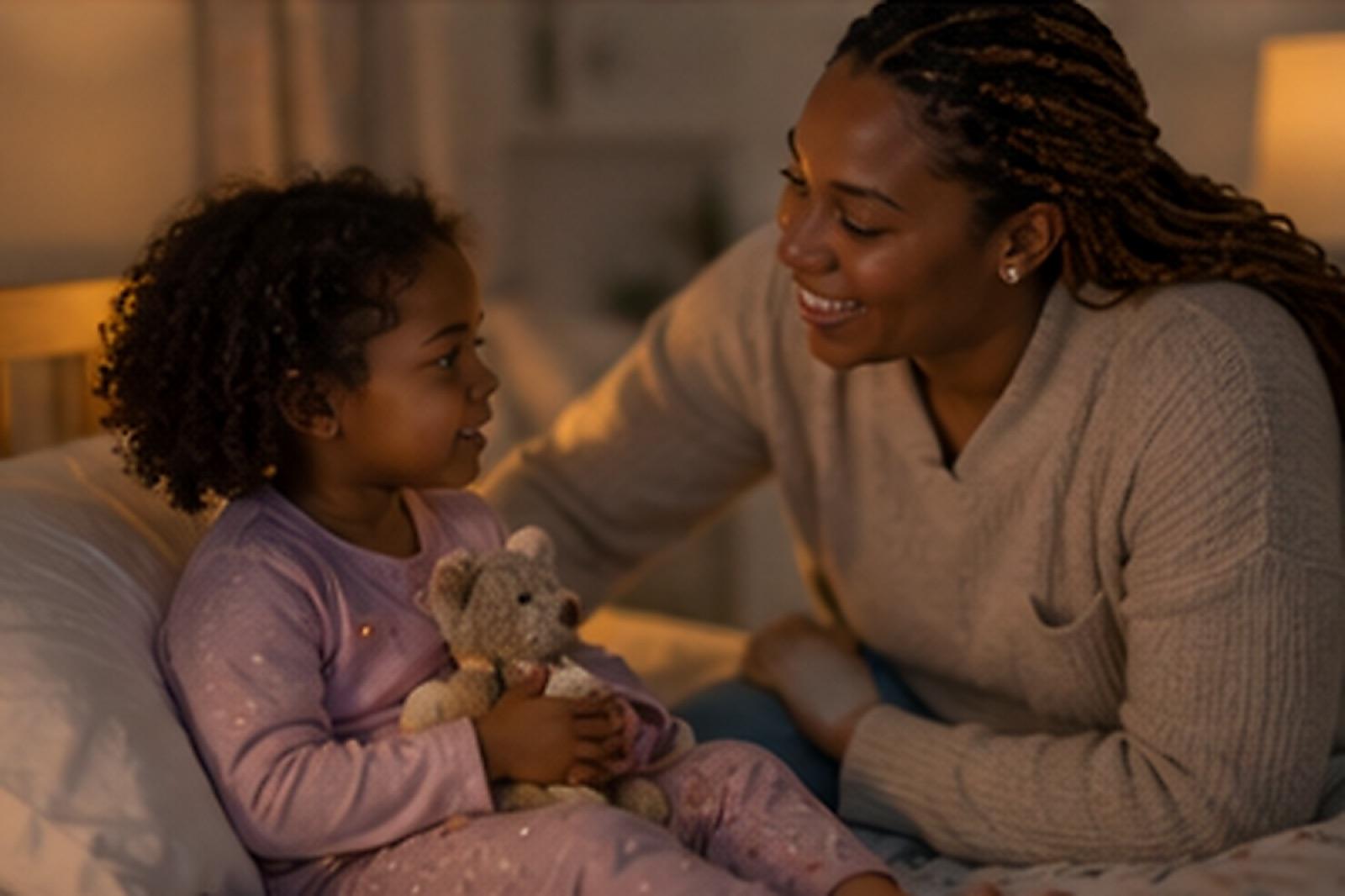
Short, predictable, visual, and the same every night, including weekends. The routine starts well before bed, because the wind-down is where most of the work happens. Here is the shape we build with most families, adjusted for age and for what your child can tolerate.
- 60 minutes before · Screens off, lights down
Tablet and TV end at a set time, announced with a timer so it is the timer, not you, saying no. Overhead lights go off and lamps go on. The last snack and drink happen now, not at lights out.
- 30 minutes before · The same steps in the same order
Bath or wash, pajamas, teeth, toilet, in the same order every night, shown on a picture schedule your child can check off. Each step is short. A child who hates toothbrushing gets a plan for that specifically, taught during the day, not at bedtime.
- 10 minutes before · Calm connection
Two books, or one song, or a few minutes of a quiet activity your child loves, in the bedroom with low light. This is the part most children will work for, so it comes last and it is never taken away as a consequence.
- Lights out · The same words, then leave
A short goodnight script, always the same, then you leave the room. If your child currently cannot fall asleep without you, the plan moves your chair toward the door a little every few nights rather than leaving all at once.
- After lights out · The plan for getting up
Decided in advance and written down: what you say, how you walk them back, how little attention it gets. Boring and consistent is the whole strategy. The sixth trip back is delivered exactly like the first.
How does ABA help with sleep?
By treating bedtime as a chain of skills, teaching each link, and making sure the whole chain is run the same way every night. A BCBA starts by watching the evening, or having you log it for a week: when the routine starts, where it breaks, what happens when your child gets up, how long until sleep, how many wakings. Then the plan addresses what the log shows.
- Teaching the hard steps during the day. If toothbrushing or pajamas cause a fight, those get practiced at two in the afternoon with reinforcement and patience, when nobody is tired. By the time they move into the bedtime routine, they are easy.
- Making the routine visible. A picture schedule on the bathroom wall turns bedtime from a series of parent demands into a sequence the child can run. Many children will race through a schedule they would fight if it came from a person.
- Changing the sleep association slowly. A child who only falls asleep with a parent lying beside them has learned that sleep needs a parent. The plan fades that, one step at a time, over weeks, without the cry-it-out approach that does not work well for most autistic children and that parents cannot sustain.
- Fixing the response to waking. Night waking usually continues because of what happens next: a snack, a show, a long cuddle, moving to the parents' bed. The plan makes the response calm and brief so waking stops being worth it.
- Adjusting the room. Blackout curtains or a dim night light, a sound machine or complete quiet, a weighted blanket or no blanket, seamless pajamas. The BCBA works out which, from your child's sensory profile, rather than guessing.
The reason an in-home provider matters here is obvious once you think about it. Bedtime cannot be practiced in a clinic. It can be talked about in a clinic, and then the parent goes home to do it alone at the worst hour of the day. Our technicians can be in your house for the evening routine during the weeks the plan is being built, and our BCBAs, who visit every family weekly, adjust it based on what actually happened on Tuesday night rather than on a report from a month ago. Parent training, which we cover in parent training in ABA, is the heart of a sleep plan, because you are the one running it at lights out.
Should I use melatonin?
That is a question for your pediatrician, and it is a reasonable one to ask. Melatonin is the most studied sleep supplement for autistic children, and the research supports it for falling asleep faster in children whose own melatonin runs late. It does much less for night waking, supplement doses vary a lot between brands, and it works best with a routine, not instead of one. A doctor should also rule out the medical causes first, since no supplement fixes sleep apnea or reflux. We do not prescribe or recommend supplements; we build the routine that makes whatever the doctor recommends work better.
How long does it take?
Most families see a real change in two to four weeks of consistent nights, and a settled routine in six to eight. The first week is often the hardest, because a child whose old bedtime routine is changing will test the new one. That is expected, and the plan accounts for it. The families who get there fastest are the ones who run the plan the same way seven nights a week, which is also why we design plans around what two exhausted adults can realistically keep doing.
Poor sleep makes everything else harder, including the meltdowns we wrote about in meltdowns versus tantrums, and a sudden rise in daytime behavior is often a sleep problem in disguise. If your child is already in ABA, ask your BCBA to put sleep on the plan. If not, our interactive ABA preview shows what a program might focus on, and our get started page is the first step. Sleep goals are covered like any other goal in a treatment plan; the plans we work with in Utah and Maryland are on our insurance page.

About the reviewer
Lily Palmer, M.Ed., BCBA, LBA
Board Certified Behavior Analyst, Golden Touch ABA
Lily Palmer is a Board Certified Behavior Analyst and Licensed Behavior Analyst with Golden Touch ABA, where she designs and oversees in-home ABA programs for children with autism in Utah. She holds a Master of Education and studied at the University of Utah.